

Commerce has a new kind of customer. It never gets tired, it can process more information in a few seconds than a person can in a week, and consumers are starting to trust it not only to inform their decisions but to make them.
In just the past couple of months, at least seven personal AI agents have launched: SpaceXAI’s Grok Bot, Instinct, Meta’s Muse, Wajo’s Fo, Manus’s Cue, OpenAI’s Dots, and Hark. Each promises to research, book, and buy on the consumer’s behalf, and together they mark the opening of a race to become the primary AI interface for everyday life.

That race is changing two things at once: how consumers spend their time, money, and attention, and how businesses compete when they have to win over both the consumer and the agent working for them. In this post, we look at the consumer side of that shift and what it means for brands. In the next, we explore the broader implications for the advertising ecosystem.
The research phase is collapsing
The research phase is collapsing
Using AI to find and evaluate products, entertainment and hospitality is no longer early-adopter behavior. It has become a mainstream part of how people discover, compare, and buy.
First Source Used by Consumers to Research Purchase Decisions
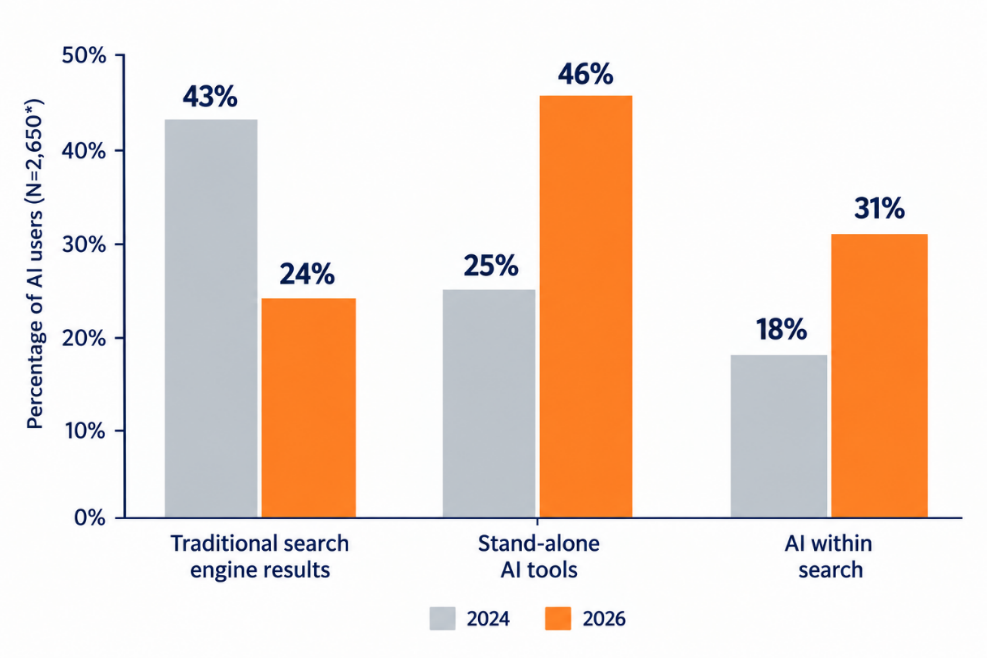
The first-order effect is simple. Consumers get more information and spend less time gathering it. Instead of opening ten tabs, reading reviews, and comparing specifications, a shopper can hand that work to an agent that already knows their preferences, budget, and context. The result is a better-informed consumer who is harder to sway.
Research time is already falling. According to Kearney, the share of consumers who spend more than 30 minutes researching a new product dropped from 28% in 2022 to 19% in 2026, while the share who finish in 15 minutes or less rose from 37% to 45%. Agents will push that trend further.
For decades, consumers paid for better decisions with their time and attention: browsing sites, scrolling marketplaces, reading reviews, and seeing ads along the way. That attention does not disappear as agents take on more of the journey. It gets reallocated, and the share of human attention a brand can still reach directly becomes scarcer and more valuable.
From discovery to delegation
From discovery to delegation
Discovery dominated the conversation at Advertising Week New York last week, where brands, agencies, and technology companies spent much of their time on how consumers now find products through AI, and how brands stay visible. GEO (“generative engine optimization”) or AEO (“answer engine optimization”) are the successors to SEO (“search engine optimization”) in the AI world and are now an integral part of the consumer journey. Zeta and MNTN, two Staley Capital portfolio companies, hosted and sponsored events throughout the week, and Zeta announced its acquisition of Senso, an AI engineering company that strengthens its capabilities in AI trust and discoverability.
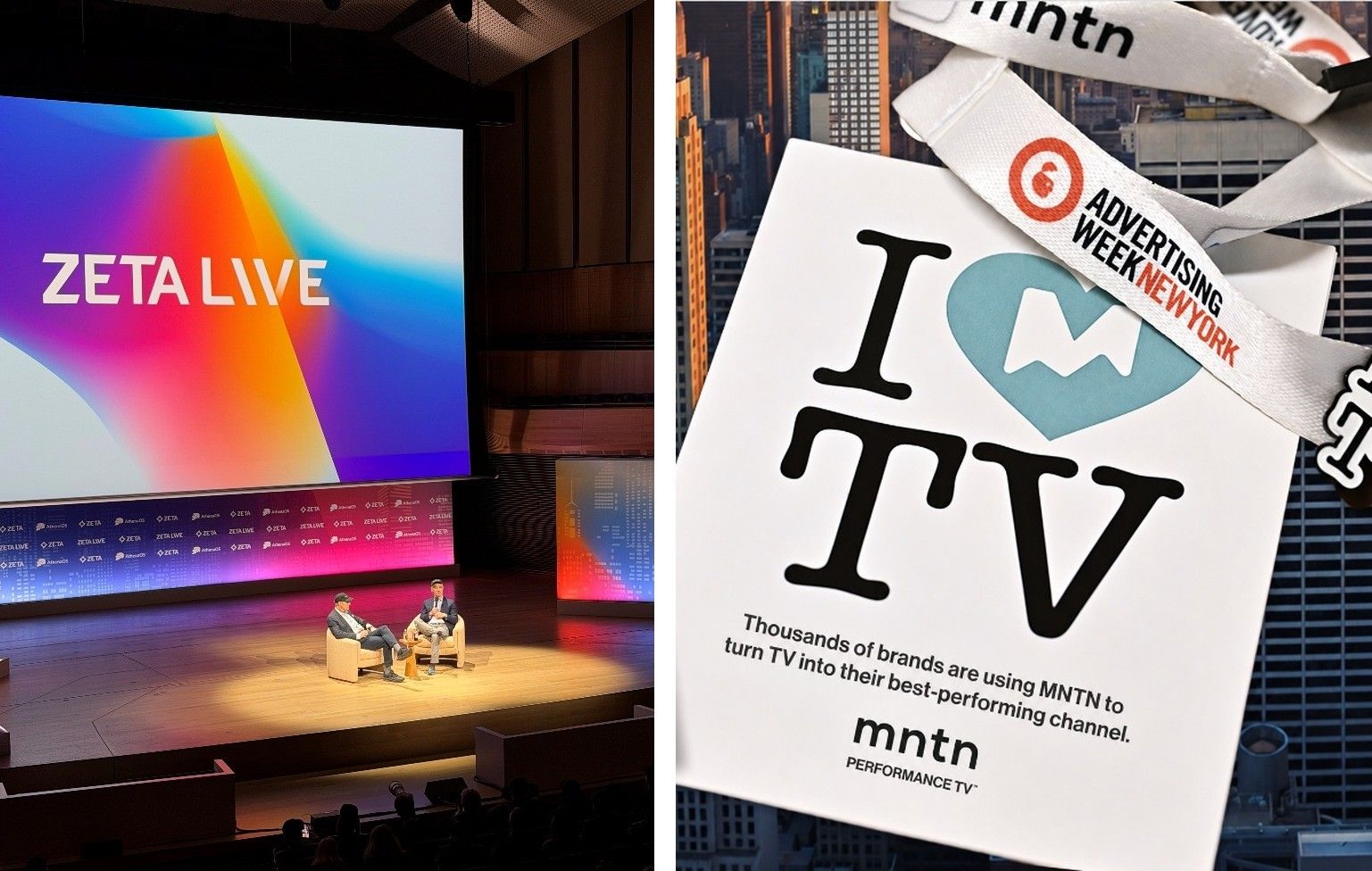
Zeta and MNTN at Advertising Week New York, October 2026
The bigger question is what happens when AI moves past recommending and starts deciding and transacting on the consumer’s behalf. At that point, an agent stops looking like another discovery channel and starts looking like a new participant in commerce, one that brands, merchants, and payment infrastructure will all have to “impress” and accommodate.
McKinsey estimates that by 2030, agentic commerce could orchestrate $900 billion to $1 trillion of U.S. B2C retail revenue, and $3 trillion to $5 trillion globally. The opportunity extends well beyond retail. Travel also offers an early glimpse of how this shift is unfolding. Consumers are beginning to use agents to research flights, compare hotels, and even make reservations and complete bookings. Instinct’s founder says the platform is closing in on $1 billion in annualized GMV, with more than half of it in travel. Over time, buying will shift from something consumers do repeatedly to something they hand off.
Trust will set the pace
Trust will set the pace
Consumers are already comfortable letting agents research and recommend. The bigger leap is giving an agent access to email, calendars, and payment details, and then letting it buy without asking first.
Consumer Delegation to AI Falls as the Journey Moves Toward Checkout
Share of consumers willing to let an AI agent act at each stage of the purchase journey
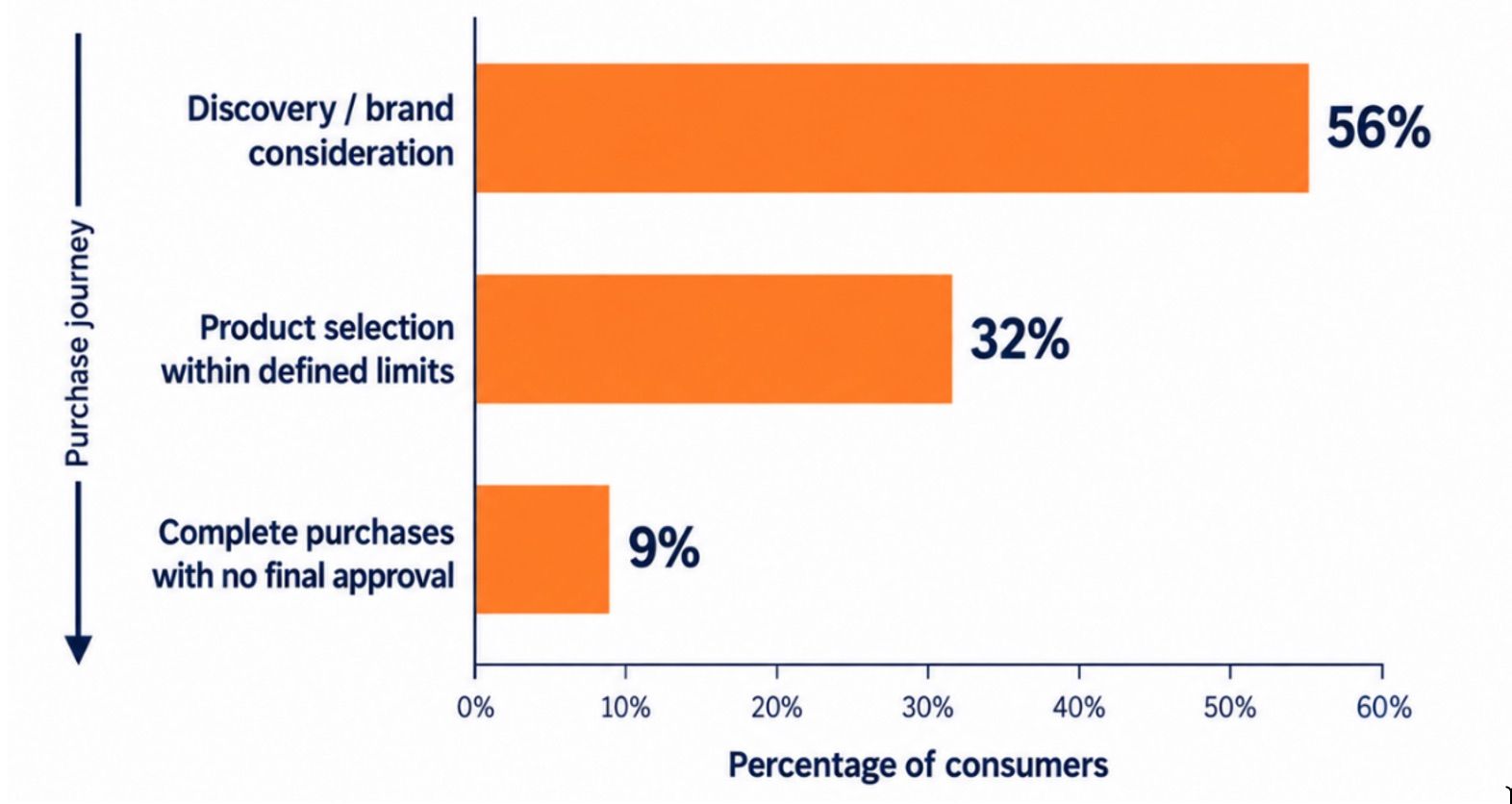
How fast that leap happens depends on trust, and trust here has several parts. Consumers need to believe an agent will choose as well or better as they would, that the platform behind it will protect their data, and that they have recourse when it gets something wrong. What happens when an agent buys the wrong product, misreads a preference, or exposes payment information? Banks, payment networks, and technology platforms are competing to become the trusted intermediary for consumer data and transactions, and every bad purchase or breach erodes confidence and could slow adoption across the ecosystem.
Willingness to delegate will also vary by purchase. We expect fully delegated buying to start with low-cost, repeat items like paper towels and toothpaste, gradually move up the value and complexity curve toward less frequent, higher-consideration purchases like laptops and outdoor power equipment as agents prove themselves, and eventually reach major purchases like cars.
In the restaurant sector, reservations are among the first experiences AI agents are transforming, with platforms such as Quenelle, ResTracker, and Auto.Res, given their relatively low commitment, flexible cancellation policies, and limited need for upfront payment. Restaurant ordering is a bigger step, as consumers must trust agents to get the details right, complete transactions, and resolve issues when something goes wrong. DoorDash’s recent launch of a text-to-order AI agent, now in testing inside Apple Messages, is an early sign of where take-out food ordering is heading.
Established consumer platforms start with an advantage. Companies that already hold payment credentials, identity, purchase history, and loyalty relationships start with a layer of trust. That also leaves room for new entrants to compete by making transparency and consumer control central from day one.
The infrastructure to support that trust is taking shape. OpenAI and Stripe’s Agentic Commerce Protocol (ACP), Google’s AP2 and Universal Commerce Protocol (UCP), Visa Intelligent Commerce, and Mastercard Agent Pay are among the early efforts defining how agents authorize, initiate, and complete transactions. The approaches differ, but together they are building the payment, identity, and authorization layer that agentic commerce needs to scale.
A new layer, not a replacement
A new layer, not a replacement
Major shifts in commerce rarely eliminate what came before. E-commerce did not end the physical store. After more than two decades of growth, online sales account for about 17% of U.S. retail, and roughly 83% still happens offline. What changed was the number of ways people could discover and buy.
Despite Decades of E-Commerce Growth, 83% of U.S. Retail Sales Still Happen Offline
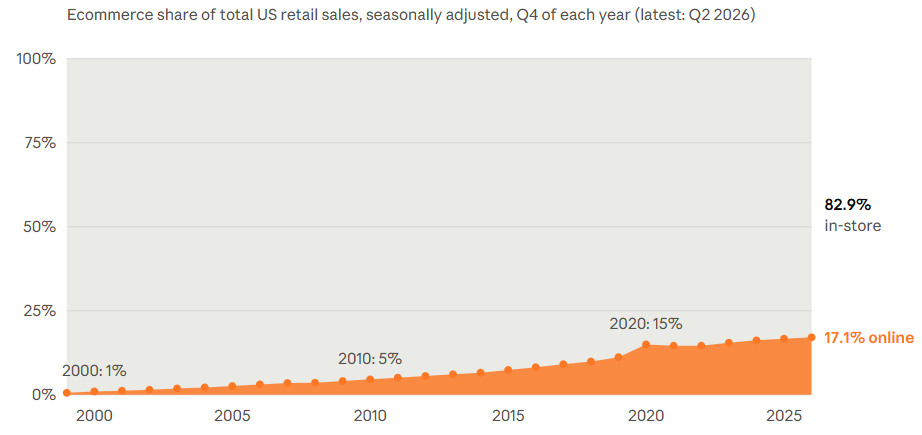
Source: U.S. Census Bureau, Quarterly E-Commerce Report (Q2 2026), via FRED
Agents add another layer. People will still walk into stores, browse brand sites, and find products on social media and through search. As more routine work moves to agents, the experiences people choose for themselves become more valuable. Stores, hospitality, and well-designed brand environments offer things an optimization engine cannot replicate: vibe, emotional connection, and immersive experiences. The same goes for content. Useful, honest content that helps people make good decisions will gain value, and the distracting kind will be easier than ever to ignore.
Entertainment already shows the pattern. Movies, sports, and music have never been easier to stream, yet people keep paying premiums for in-person experiences. IMAX had its best year ever in 2025, with global box office up 40% to a record $1.28 billion. The average ticket price for the year’s top 100 concert tours rose from about $96 in 2019 to $133 in 2025, up roughly 38% against about 26% inflation. And at the 2026 World Cup, stadiums ran at 99.7% capacity through the Round of 16, even with ticket prices well above Qatar 2022 levels.
Retail is where this dynamic matters most to us. Roughly 83% of retail sales still happen in the store, yet less than 1% of retail media spend is in the store, a gap we explored in Retail Media Went Everywhere Except the Aisle and the thesis behind our investment in Looma. As agents absorb more upstream research, the moment a shopper stands in front of the shelf becomes one of the few places a brand can still reach someone directly. That makes media at the point of purchase, and the ability to measure whether it worked, more valuable as agentic commerce grows.
Brands now have two audiences
Brands now have two audiences
The result is that brands have two audiences to win: the person, and the agent acting on that person’s behalf. Each one takes a different playbook to reach and influence.
When an agent can instantly compare price, specifications, ratings, and availability across hundreds of alternatives, quality and performance differences become easy to evaluate and hard to obscure. Brands that haven't invested in real differentiation or a meaningful connection with customers risk losing ground to cheaper alternatives and private label, especially in the replenishment categories we expect consumers to delegate first. Brands with genuine consumer affinity move the other way. A consumer who asks for Nike rather than “the best running shoe,” or Apple rather than “the best laptop for me,” gives the agent a specific brand as the first step, rather than one of the variables to consider.
Brand presentation will also become more personal. Generative AI lets brands adapt messaging, creative, and digital experiences to each person’s preferences and intent. Two consumers may experience the same brand very differently on digital platforms, and the strongest brands will maintain the qualities that make them recognizable and trusted across every version.
Agents need something else entirely: structured information they can evaluate, including product attributes, pricing, inventory, reviews, delivery times, return policies, and compatibility. People have limited attention and therefore lean toward summaries, simple recommendations and strong visuals. Agents have no such limit and do better with depth and detail. Agents don’t need an emotional connection or background music. Information built for one audience often fails the other.
For brands, the task comes down to earning two things: enough human preference to be requested, and enough machine credibility to be selected.
In our next post, we look at what this means for advertising, and at the harder question of what a sponsored recommendation looks like when the buyer is an agent.