

In our last post, we looked at how AI agents are changing the way consumers research and buy, and why brands now have to win over both the person and the agent working for them. Here we turn to the business model that has funded nearly every major consumer interface before them: advertising. Staying visible to AI agents is the first step, and table stakes, in this new era. The larger question is what advertising becomes when an agent, not a person, is doing the “shopping” and decides what to buy.
Advertising follows the interface
Advertising follows the interface
Every major consumer interface has eventually built a large advertising business around access to consumer eyeballs: search, social, connected TV, and more recently retail media. The race to own the AI interface is following the same path. Subscriptions will matter, but advertising has paid for most of the largest consumer internet platforms, and the two models can coexist or be combined. Netflix is a great case study: it resisted advertising for years before launching an ad-supported tier in 2022. By Q1 2026, more than 60% of Netflix's new subscribers chose the ad-supported tier in markets where it was available, and the company expects advertising revenue to reach about $3 billion in FY2026.
Netflix: Ad-Supported Share of New Sign-Ups
Percentage of new subscriptions choosing the ad-supported tier in markets where available
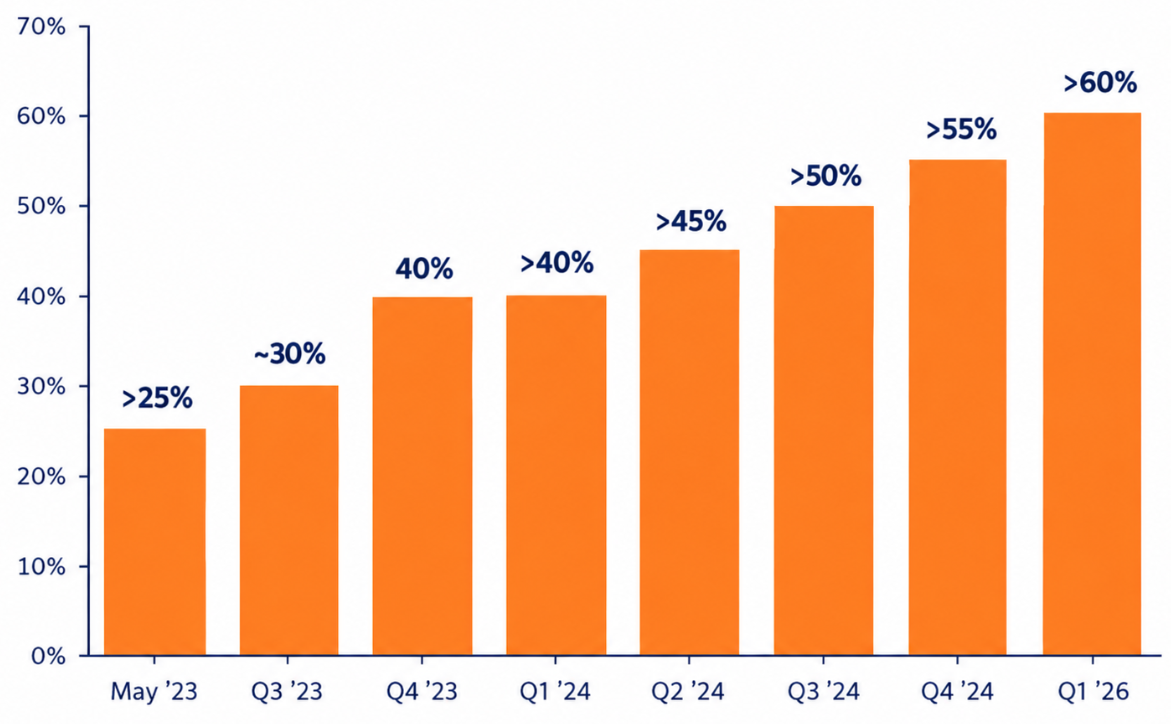
Source: Netflix shareholder letters and company announcements, 2023–2026. Figures reflect company-reported percentages or thresholds, not exact values. No new figures were disclosed for 2025.
The leading AI platforms are splitting on the advertising question. Anthropic has positioned Claude as an ad-free alternative, while OpenAI is building an advertising business. ChatGPT began showing ads in February 2026 and passed a $1 billion annualized gross advertising revenue run rate in under 200 days. WPP Media projects global generative search advertising revenue will rise from $5.1 billion in 2026 to more than $100 billion by 2030, potentially making it the fastest-growing advertising channel in history. The debate over ads or no ads by AI leaders is so intense that Anthropic bought Super Bowl ads (THE most expensive advertising forum) in February 2026 to make their point. Other platforms will make different choices, but that pace shows how large advertising inside consumer AI could become.

Source: Anthropic
The first wave of ChatGPT ads looks familiar: a relevant, clearly labeled ad placed beside an answer, the playbook Google pioneered in search over 15 years ago with Product Listing Ads (“PLA”), which is now the standard result of a Google product search that produces pictures of competing products, with hot links to brands and ecommerce sites. For an AI query, this is a natural first step and will feel normal to a consumer.
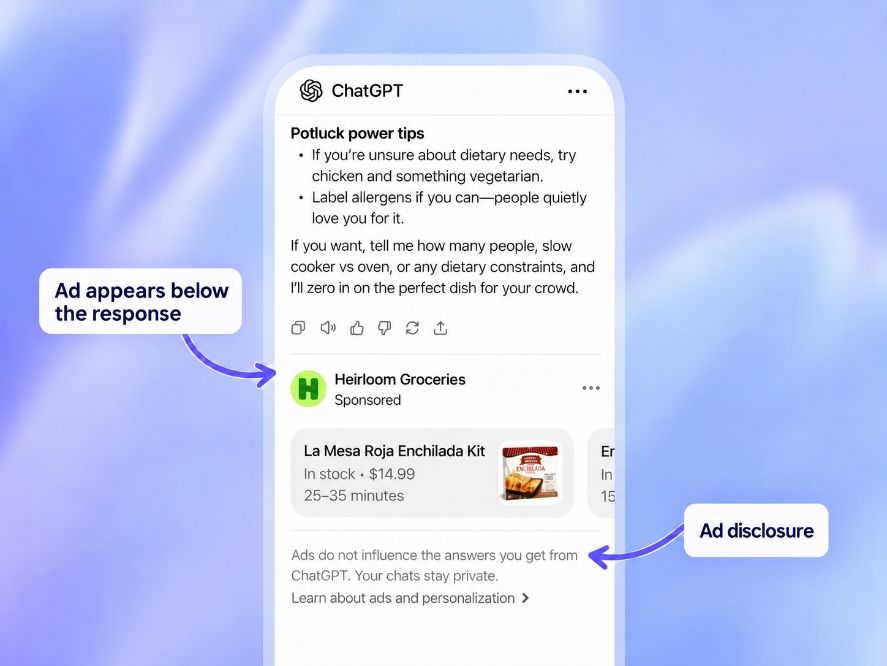
An ad placed below a ChatGPT answer. Source: OpenAI
While still early, the format is already evolving towards AI-powered conversations, where human consumers can engage directly with advertisers, ask follow-up questions, explore products, and move closer to a purchase without leaving the interface. For brands, this creates an opportunity to turn advertising from a passive impression into an interactive exchange tailored to consumer intent. Done well, these experiences could make advertising more useful and relevant to consumers. Done poorly, they risk blurring the line between helpful recommendations and paid promotion, undermining the trust consumers place in AI platforms.
Influencing the agent with “shadow ads”
Influencing the agent with “shadow ads”
Agentic commerce introduces a new audience for advertisers: AI agents that make recommendations and purchase decisions on consumers' behalf. How does a brand get into an agent’s consideration set? And what counts as a sponsored recommendation when the agent is supposed to act in the consumer’s interest?
The leading AI platforms are working to earn consumer trust by promising that advertising will not influence their answers. The most consequential forms of influence in agentic commerce may never appear in the answer delivered to the consumer. A merchant, or a merchant’s own AI agent, could offer a consumer’s agent a discounted price, a loyalty incentive, or a commission that shapes how options are ranked before the consumer sees anything.
These behind-the-scenes incentives, or “shadow ads”, may not affect what an agent tells the consumer, but they could influence its decisions in ways that don't necessarily serve the consumer's best interests. Imagine asking an AI agent to find the best deal on a pair of headphones. One retailer offers them for $180, while another charges $190 but includes a $20 credit toward a future purchase. The agent may favor the second offer, even though the consumer pays more if they never use the credit. Alternatively, a retailer could offer the agent platform a commission on certain products, potentially influencing it to recommend a similarly priced pair with weaker customer reviews. While the stakes in this example are relatively modest, similar incentives influencing more consequential purchases or financial decisions could have far greater implications for consumers.

Whether agent platforms treat these incentives as disclosed advertising, as a private commercial term between agent and merchant, or as something they refuse outright is still an open question. The answer will shape both how far consumers trust their agents and where advertising dollars ultimately flow.
Either way, a new advertising ecosystem is forming around agent-mediated intent. Brands will look for ways to communicate directly with personal agents, offering tailored product information, exclusive pricing, or terms built for a specific shopper’s request. As agent-to-agent buying becomes more common, we expect these “shadow ads” to proliferate, making transparency increasingly important to maintaining consumer trust. How those exchanges are disclosed, and to whom, will decide whether they read as useful offers or as hidden steering, objectively not in the best interest of the consumer.
Measurement has to be rebuilt
Measurement has to be rebuilt
When an agent researches, compares, and buys, there may be no ad impression, click, or site visit connecting marketing to the sale. Brands are already scrambling to determine not only whether they appear in an agent’s consideration set, but whether their marketing changed the agent’s selection and drove sales that would not have happened otherwise. We expect a new layer of infrastructure to form around measuring agent-driven activity, tying it to real purchases, and proving value across an increasingly fragmented ecosystem. But the challenge goes beyond attribution. As AI platforms increasingly sit between consumers and merchants, they may also control access to the consumer interactions and transaction data that make measurement possible.
The Battle for the Consumer Relationship
This raises a broader strategic question for businesses: how much control over the consumer relationship are they willing to give up in exchange for access to customers through third-party AI agents?
This tension is already playing out among major retailers and marketplaces. Amazon has restricted third-party shopping agents, including Meta’s Muse and Perplexity’s Agent, while simultaneously investing in its own shopping assistant, Alexa for Shopping (formerly Rufus). eBay has similarly restricted unauthorized third-party agents while developing its own personalized AI shopping agent and selectively partnering with outside AI platforms. The resistance extends beyond retail: JPMorgan Chase and Charles Schwab block third-party AI agents from accessing customer accounts, and Delta Air Lines restricts their ability to book flights through its platforms.
The resistance is not necessarily to agentic commerce itself, but to ceding control of the consumer relationship to a third-party agent. Maintaining that relationship allows companies to retain valuable customer data, influence product discovery, preserve advertising and monetization opportunities, and maintain greater control over security, liability, and the customer experience.
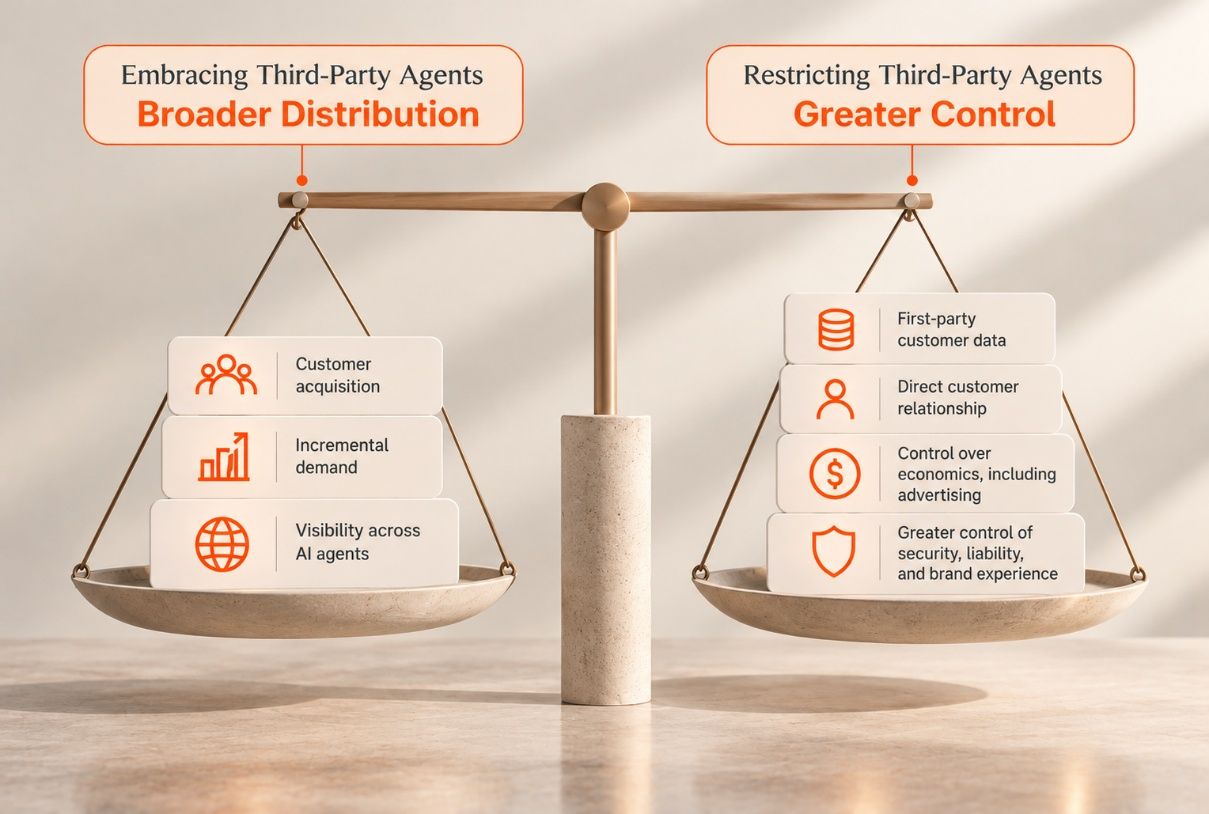
Others are taking a more open approach. Walmart has partnered with third-party agents, including Meta's Muse, while simultaneously developing its own shopping assistant, Sparky. Target has similarly embraced external AI platforms, including ChatGPT, Gemini, and Microsoft Copilot. These approaches suggest that even the largest companies may view third-party agents as valuable distribution channels, rather than purely competitive threats.
Not all merchants, however, have the same flexibility with third-party agents. The largest retailers and marketplaces already have the customer base, data, and resources to develop proprietary AI experiences. They can afford to be more selective about which agents access their platforms, particularly when doing so could threaten their existing customer relationships and advertising businesses.
Smaller merchants have less leverage. They may have little choice but to embrace third-party platforms to remain competitive.
We expect a new market of companies to emerge that helps level the playing field for smaller merchants by expanding their distribution while retaining greater control over customer relationships, data, and economics. Shopify's Agentic Storefronts offer an early example, enabling small merchants to sell across multiple AI platforms through a single integration while retaining their checkout infrastructure and customer relationships. Klaviyo's Customer Agent offers a complementary approach, enabling small merchants to deploy their own AI shopping assistants using first-party data, helping them maintain direct relationships with consumers. Much like e-commerce platforms democratized online retail, this emerging infrastructure could allow smaller businesses to participate more effectively in agentic commerce without becoming overly dependent on third-party intermediaries.
We have seen a similar dynamic play out across a number of industries. Restaurants rely on marketplace platforms like Uber Eats and DoorDash for ordering and delivery, and Resy and OpenTable for reservations, while hotels rely on OTAs (online travel agencies) like Booking.com and Expedia. These intermediaries drive discovery and customer acquisition, but at the expense of the customer relationship for the underlying brand. Consumers become accustomed to OTAs getting paid by airlines, hotels, and cruise ships, and to food delivery services taking a commission on food ordered through their marketplaces, will the same acceptance hold when agentic agents get paid or “bribed” through a mechanism largely invisible to their consumer client?
Larger restaurant chains and hotel groups can leverage their brands, loyalty platforms, and direct booking channels to reduce reliance on intermediaries. Smaller operators, however, often lack that flexibility and depend on these platforms for customer acquisition even when the economics are unfavorable.
In the restaurant ordering space, Olo, a Staley Capital portfolio company, has introduced an alternative with the launch of its consumer-facing “Olo App”. Built around what Olo calls second-party ordering, the platform brings restaurants together into a shared discovery and ordering network without charging restaurants marketplace commissions. Restaurants retain their guest data and direct customer relationships while benefiting from broader distribution, combining marketplace reach with the economics and data ownership of direct ordering.
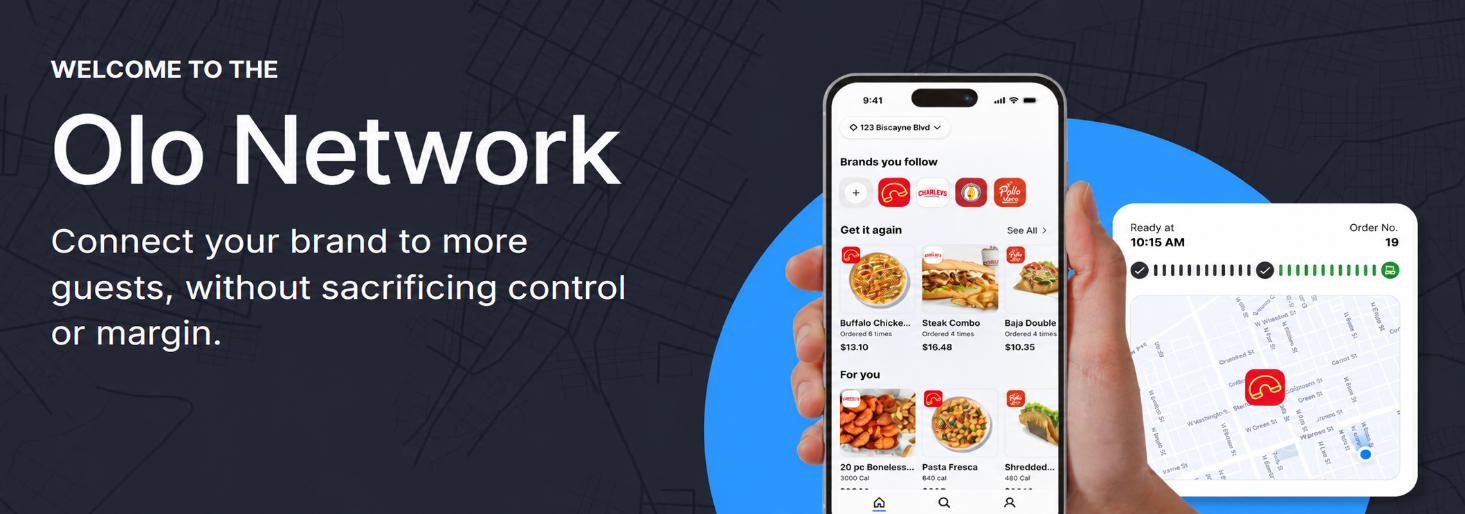
Source: Olo
Agentic commerce could introduce a similar dynamic across a much broader range of industries, although the underlying economics and business models are still taking shape. As AI agents increasingly sit between consumers and merchants, businesses will need to determine where third-party distribution creates incremental demand and where it risks displacing existing customer relationships. Ultimately, who controls that interface will influence not only where purchases take place, but where advertising dollars, customer data, and transaction economics accrue.
Where we are looking
It is still early. Fully autonomous buying will arrive gradually, and human-led discovery and shopping won't disappear. But the direction is clear enough to invest against.
At Staley Capital, we focus on the companies forming between consumer intent and the transaction: data platforms that help agents discover and evaluate products, commerce infrastructure that lets them transact safely, and advertising and measurement technology that keeps brands relevant to people and the agents acting for them. If you are building in any of those layers, we would like to hear from you.