
In our first post in this series, we laid out the data behind the retreat of Western brands in China. Here we examine the deeper question: not what happened, but why, and what it reveals about how consumer markets mature in ways that most brand owners fail to anticipate. The implications extend well beyond China and well beyond consumer goods.
There's a version of the Western brand story in China that sounds like a cautionary tale about geopolitics. Tariffs came in, national sentiment shifted, and consumers turned inward. That version is not wrong, but it is incomplete.
The more interesting explanation starts not with trade policy but with the Cultural Revolution.
Where the story really begins
Where the story really begins
When Western brands first entered China in earnest in the 1980s, after decades of enforced uniformity under Mao, they were helping shape a market as much as selling into one. During the Cultural Revolution, individual expression was suppressed as a matter of state policy. Citizens were required to dress identically: gray, black, or dark blue. When those constraints ended in 1976, an entire society was suddenly unleashed into a world of choice. A generation came into adulthood with rising disposable income, an appetite for self-expression that had been suppressed for decades, and a relatively limited set of sources telling them what was cool. Those sources were Vogue, the Paris runway, and Milan Fashion Week. Western brands, operating at their peak, stepped into that vacuum and helped define what aspiration looked like for a new generation of Chinese consumers.
In doing so, they introduced a generation of Chinese consumers to the vocabulary of modern branding: what to expect from a premium product, how to evaluate quality, and what it meant to make an aspirational purchase. By the early 2000s, Chinese consumers were among the most engaged and aspirational in the world. They absorbed the model completely.
And then those consumers looked around and realized they had choices.
A new generation resets the terms
A new generation resets the terms
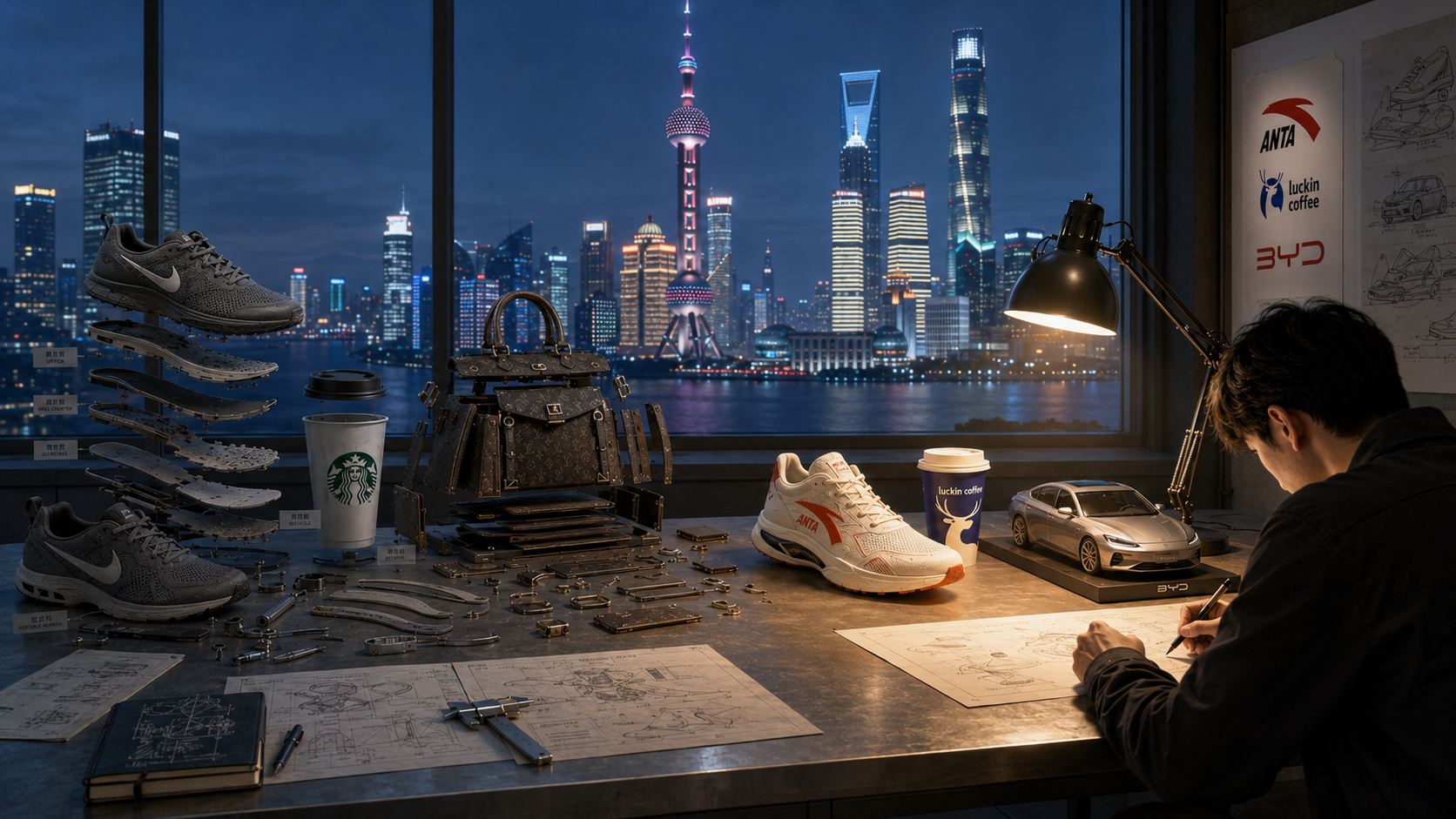
The early model worked because that first generation of post-Cultural Revolution consumers embraced Western brands with an intensity that was, at the time, entirely understandable. The Western label carried intrinsic value, independent of product quality or local relevance. That intensity eroded as domestic brands matured, as disposable incomes rose, and as a new generation came of age that never shared their parents' reverence for foreign goods. Millennial and Gen Z Chinese consumers didn't grow up treating Western brand names as status symbols. They grew up with their own influencers on TikTok and Instagram rather than the fashion icons in New York and Paris that guided their parents. They grew up in a market where Anta was already a serious company, where Luckin was innovating faster than Starbucks, where BYD was engineering cars that competed with anything on the road.
The old system of fashion houses launching spring and fall collections at Paris runway shows, with the whole world falling in line, had already begun to crumble globally. In China, it crumbled faster and more completely because the new generation had both domestic alternatives and social media infrastructure to build entirely new taste hierarchies from the ground up.
The accountability gap
The accountability gap
What most Western brands missed was predictable in retrospect. They were managing the supply side of the relationship: producing goods, expanding distribution, projecting brand imagery into the market. What they were not doing was tracking the demand side with equal rigor: how consumer expectations were evolving, how the value proposition of "Western" was depreciating, and how quickly domestic competitors were narrowing the product and experience gap.
Those competitors didn't start from scratch. They reverse-engineered what Western brands had built. In the same way an auto OEM tears apart a competitor's vehicle to study every bolt and line of code, Chinese brands studied Starbucks and built Luckin. They studied Nike and built Anta. They studied the entire Western fast fashion model and built Shein. There is no monopoly on a good idea, and once a generation of Chinese consumers learned what good looked like, Chinese companies got to work making it better and more efficiently.
That knowledge transfer also had a more direct channel. At its peak in 2019, 372,000 students from mainland China were enrolled in US colleges and universities. Today, that number stands at roughly 265,000, still the second-largest foreign student population in the country after India. These students spent four years in American institutions, observing how American companies built brands, told stories, and cultivated consumer loyalty. Most went home, and many of them, along with a generation of Chinese entrepreneurs who never left, applied what they had learned to building something better suited to the Chinese consumer they understood far more intimately than any Western brand ever did. The brands that survived and grew in China understood this. They didn't wait for the market to tell them they had fallen behind.
A brand that takes its premium seriously earns it continuously. It listens to its market, evolves its product, and makes the customer feel seen. Some Western brands did this in China and are still growing. Hermes built and maintained genuine scarcity, allowing it to hold pricing power in a market where most of its peers have been forced to discount. Adidas, after suffering seven consecutive quarters of decline in China, rebuilt by localizing aggressively: locally designed products now make up about 60% of its China apparel and footwear assortment, up from low single digits before the reset. Those brands treated China as a market to serve, not a market to extract from.
Most others did not. They raised prices, leaned on legacy positioning, and when results softened, blamed the macro. Nike's revenue in Greater China has now fallen for seven consecutive quarters or more. And yet, the public narrative from many of these brands still leads with tariffs and consumer confidence as the primary explanations, rather than with an honest accounting of how they fell out of step with the consumers they were supposed to serve.
The strategic lesson
The strategic lesson
When you enter a massive, growing consumer market, you are not just selling. You are building expectations. If you build well, you create loyal, sophisticated customers. But sophisticated customers are demanding. They compare. They expect innovation and refreshed styles. They know what looks stylish and culturally relevant. They will leave when you stop earning their preference.
China's consumer market has matured. Western brands, by and large, did not keep pace with that maturation. They focused on extracting value from a market that was ready to extract value back.
At Staley, this is the kind of structural accountability we look for when evaluating any company operating across consumer markets. Not just 'how big is the market,' but 'how well does the company understand where its customers are headed, and is it moving with them?' The brands that got China wrong often failed that test, not because the future was unforeseeable, but because they weren't looking. We study these dynamics not to invest in the brands being disrupted, but to identify second-order opportunities that emerge when a major market undergoes such a reset.
In our next post, we turn to the other half of the story: what happens when the traffic starts flowing the other way.